a conversation between two friends separated by one state, sharing the same passion for the art of knitwear.

knitorious is an archive for knitwear designers, knitwear students, knitwear lovers and even the knitwear curious.

3.27.2011

inspiration for this new week

Year 2000 | Nepal


Prithvi Narayan Shah, first king of Nepal, called his realm "a garden for
all types of peope," including some 60 ethnic groups. Few had more influence
than the Newars, who were renowned for their art and architecture. In Bhaktapur,
a Newar (first photo) wears topi and khasto for a morning stroll. Nearby, a child plays
while her mother works in a brick factory. A Newar girl (third photo) visits
Swayambhunath, Nepal's oldest Buddhist stupa.

Cataracts are the leading cause of blindness worldwide, and Himalayan
nations may suffer most. In Nepal, the condition caused more than
80 percent of curable blindness. The reason the region is so affected is
unknown, but researchers suspect genetics, diet, and the intense ultraviolet
radiation at high altitudes. Lack of eye care is another factor. Nepal has one
ophthalmologist for every 300,000 people.

A family takes rooftop tea above the fray in the heart of Kathmandu.
The once rural valley, home to 1.6 million, is now threatened by
sprawl. Urban populations may double in the next decade.

Nepal has been called an "impossible phantasmagoria"-- a land of
harsh realities infused with the surreal. Like a young Tharu girl perched
on a support post of a traditional longhouse in the remote Dang Valley,
Nepal seems to levitate between East and West, past and future.

Such growth in population has lead to some of the worst smog
in Asia and pushed farmers to fertile lands to the south, beyond
steep hillside terraces like these near the town of Nagarkot.

"I'm goin' to Katmandu!" wailed rocker Bob Seger in the
70's as the city became a magnet for young foreigners looking
for an earthly Shangri-la. The flower children have given way to
adventure travelers in Thamel, the city's tourist quarter. Nearly
half a million tourists visit Nepal each year, fueling the economy.


Year 2000 | Libya
Sign of a devout household, butchered sheep, sacrificed for a Muslim holy
day, intrigue a Moroccan girl in Tripoli's Old quarter.

Grainfields and citrus groves border the Libyan coast, while farther inland
the Sahara covers 90 percent of the country. Oil fields make the nation of
five million people one of Africa's richest states.

Offices and high-rises, the latest stratum of buildings in 2,600-year-old
Tripoli, Libya's capital city, climb above the cramped urban core.

The Old Quarter huddles inside city walls built in the second
century by Romans, who also left behind the noble ruins of
Leptis Magna on the Mediterranean shore.

Preserved since the 12th century, a fortress-like treasury, honeycombed with
vaults, provided the villagers of Kabaw a place to hide grain from desert raiding parties.


Alone with the wind, Berber men, members of a once dominant
pastoral people, prepare for evening prayers in the Nafusah highlands.

A Vietnamese laborer endures the Sahara's sting as he works
in the Al Sharara oil feild.

Photos and excepts: National Geographic | November 2000

something new from Jil Sander...


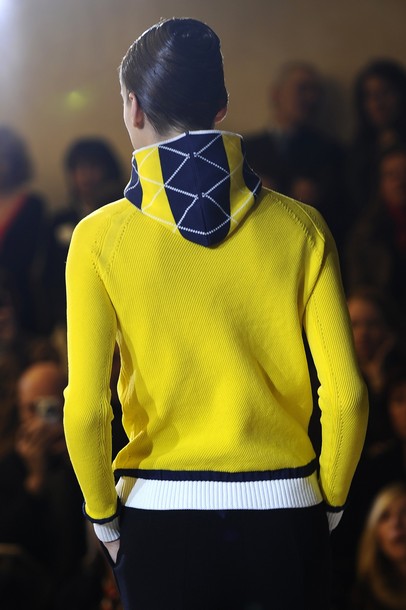
there was a bit of a mid-century ski resort vibe with Jil Sander's new collection and I was digging it! you know what that means, primary-coloured sweaters galore! awesome intarsias, crayon-coloured geo-jacquards, textured striped tuck stitches and more! and as a side note, that makeup was LOVELY. i might be trying out that turq eyeliner with my Lady Danger Mac lipstick this spring!


space!


that yarn is just great! it looks like wires... the candy, livewires, actually!


hoods!

and some vintage inspiration...


3.25.2011

artist in focus: Will McLeod

Artist Will McLeod is a great friend of mine.
When we get together, we consider strategic ways to move forward with our plans.
After, our conversation always finds it's way back to the meaning in what it is to be people.
What's it all about? How do we feel and who are we meant to provide for? After all,
we choose to dedicate significant time towards learning a craft that clothes humans. To protect them,
or make them feel something today, tomorrow, and to predict what will happen next. To consider the
place where people live, where we live, and how to prepare for a future on a planet that's a-changin' steadily.
.
We consider ways to be self-sustaining and how to acquire space. From there forward,
it's conversation of animal hair and hand-crafted technique. Machinery already in our possession,
and what we must still attain, what we can build. Business plans and future vacations in the sun.
Materials, colors, textures, sounds, something, and absolutely nothing at all.


Both Will and I share an interest in felt as a medium. This, for me, began when we were
working on a project in the library at FIT, maybe for english. Will showed me a book by German
artist Joseph Beuys, a highly influential creator of the 20th century. He favored two materials for his
work in traditional and performance art, felt and fat. Now, we speak of the uses and importance
in fabric making. How to create seamless garments. Pieces perfectly custom fit to a specific
individual's shape, or rather, aimed to drastically change or emphasis that shape. The possibility in
achieving all of these different textures and color. We speak of ways to create fabric on a
larger scale. An operation that would allow us to make yards of this imagined fabric.
His sketch shown above has inspired me to create the swatch seen below.

collaborative wool felt swatch #1 | 100% wool roving


Will's ideas for collaborative pieces, such as machine sewn blouses and simple shifts
with wet/needle felted collars, yokes, and sleeve cuffs, have also been put into action.
Releasing us from the dificulties of fusible interfacing and time spent on tricky
construction. Also, endless hand-dying possibilities... hand-beading, too.

Hand-dyed hem appears to be of natural progression, like rain water stain after spring months.


This sketch depicts an idea for a dress in this webby, drop stitch sort of fabric.
I think some of these more structured panels could be a contrast of lightweight, felted
fabrics with the same loopy pattern needle-felted into it. Like this one maybe,


collaborative wool felt swatch #2 | 100% wool roving as a base, needle felted
detail using a poly/mohair blended yarn.


Hand-painted tights peaking from this futuristic one...
Also a brilliant way for us to collaborate on looks, rather than single pieces.
I've done a bit of work in hand-painted tights too, using procion dyes and painting free-form.


The layering of pleated fabrics is a technique quite familiar to Will.
Please take a look at what I mean, on the artist's website.
His S/S collection demonstrates a masterful understanding of seam work,
naturally occuring movement, and color relation.

To be continued...